Table of Contents
October 1st 2026 Sees upated And New DGT Traffic Laws
We are going to look at the New DGT Traffic Laws, for those who drive here in Spain. If you’ve been driving in Spain for a while, you’ve probably built up a mental rulebook that’s mostly right, occasionally out of date, and every so often flat-out wrong. Well, on 1 October 2026, a big chunk of that rulebook gets rewritten. Not by a viral Facebook post or a well-meaning YouTuber — by an actual Real Decreto, published in the Boletín Oficial del Estado, the same way every serious change to Spanish law happens.
This is one of the biggest overhauls of the Reglamento General de Circulación (Spain’s General Traffic Regulation) in over twenty years. The official reasoning, straight from the preamble of the law itself, is that Spanish traffic rules have spent two decades focused on the road and the vehicle — and it’s time they focused on the person instead. For the first time, Spanish law formally defines a “usuario vulnerable de la vía” — a vulnerable road user: pedestrians, cyclists, motorcyclists, moped riders, and anyone on an electric scooter. Almost everything in this reform flows from that one idea.
I’ve gone through the actual legal text — Real Decreto 518/2026, de 24 de junio — line by line, along with the DGT’s own press release, so you’re not relying on a 90-second reel that might have half the details wrong. Here’s exactly what’s changing, what it means in practice, and what it’ll cost you if you ignore it.
🚴 Overtaking Cyclists: The Rules Just Got Stricter (and Slower)
If you drive anywhere with country roads — which, if you’re reading this, is probably most of your life in Spain — this is the section to actually read carefully.
Slow down before you pass
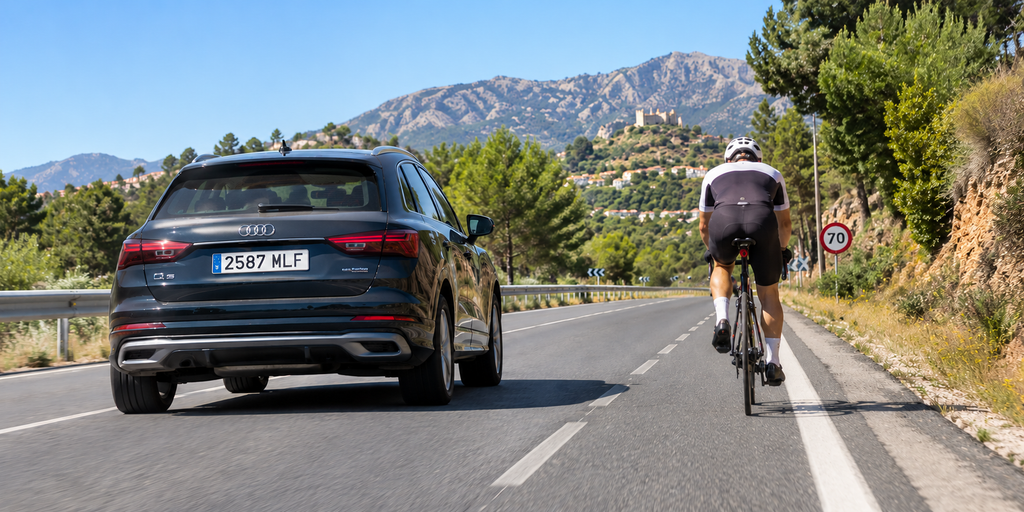
Outside built-up areas, overtaking a cyclist now requires you to reduce your speed by at least 20 km/h below the posted limit, starting before you begin the manoeuvre and continuing all the way through it. So on a road signed at 90 km/h, you need to be doing 70 km/h or less for the entire overtake — not just the moment you pass.
It’s a genuinely different philosophy from the old rules, and the law is explicit about why: when there’s already a big speed difference between a car and a cyclist, protecting the more vulnerable person means slowing the car down, not speeding through the manoeuvre to make it shorter. That’s the opposite of how a lot of people were taught to overtake.
No more squeezing past — change lanes properly
The old 1.5-metre passing distance still applies as a baseline. But if the road has more than one lane in your direction, that’s no longer good enough on its own: you now have to move completely into the next lane to overtake a cyclist, rather than just nudging over within your own lane. On a dual carriageway, half-hearted overtakes are officially over.
New in town: a 5-metre following distance
Here’s the one that catches people out, because it’s not about overtaking at all. In cities and towns, if you’re driving behind a cyclist in the same lane, you now have to leave at least 5 metres between your car and their bike — even if you have no intention of passing them any time soon. Tailgating a cyclist through town, something plenty of drivers do without thinking twice, is now a specific, named infraction.
🛴 Electric Scooters and Personal Mobility Vehicles (VMPs)
Patinetes have exploded in Spanish towns over the last few years, and the accident numbers — hospitalisations, head injuries — have exploded right along with them. This section of the reform is the government’s direct response.
15 is the new minimum age, full stop
There’s now a single, hard national minimum: you must be at least 15 years old to ride a VMP anywhere in Spain. The law’s own reasoning describes this as the age considered reasonable for handling the risks involved. No more grey area, no more “well, my council doesn’t really enforce it.”
Helmets: mandatory, and not delayed
Every VMP rider needs a correctly fastened, approved protective helmet — and unlike some of the other rules in this reform, this one has no grace period. It’s enforceable from day one, 1 October 2026.
Reflective vests: night-time for most, all the time for couriers
If you’re riding a VMP after dark or when visibility is poor, you now need a reflective vest. If you’re doing it professionally — think delivery riders, last-mile couriers on scooters — you need to wear it the entire time you’re working, day or night. The DGT has confirmed both the helmet and vest rules are classed as serious (grave) infractions, carrying a €200 fine each.
Daytime lights: real, but not yet
Here’s a detail most of the social-media coverage gets slightly wrong. Yes, VMPs will eventually need to run their lights during the day, not just at night. But that specific obligation doesn’t actually become law until 1 October 2027 — a full year after everything else in this reform. It’s not that fines are “paused” on an active rule; the daytime-light requirement simply doesn’t exist yet. Until then, lights at night or in poor visibility is all that’s required.
Pavements are still completely off-limits
Riding a scooter or bicycle on a pedestrian pavement remains flatly illegal everywhere in Spain. The only carve-out: a local council can choose to let children up to 12 cycle on the pavement if a walking adult is supervising them — and even that’s optional, not a national right.
🏍️ Motorbikes and Mopeds: Gear Up Properly
If you ride a moto or a ciclomotor, this reform adds real teeth to what used to be more of a suggestion.
Gloves on interurban roads
Both rider and passenger now need protective gloves whenever you’re on a road outside a town or city. One useful wrinkle: the exact technical specification for “approved” gloves is still being worked out via a separate ministerial order. Until that’s published, you just need to keep wearing gloves of the same kind already in common use — there’s no new product standard to go shopping for yet, even though the obligation itself is live from day one.
Closed shoes, every road, no exceptions
Flip-flops, sandals, anything open-toed — done. The law requires closed footwear that covers the whole foot, on every type of road, for motorbike, moped, three-wheeler and quad riders and passengers. It’s easy to laugh this one off until you remember why it exists: an open sandal offers precisely zero protection in a low-speed drop, which is exactly the kind of accident most riders actually have.
Ciclomotor helmets: one year to upgrade
If you ride a moped with a helmet that’s merely “certified” rather than fully “homologated” (type-approved), you get a genuine grace period here — you can keep using it until 1 October 2027. This is a separate delay from the VMP daytime-lights one above, and it’s easy to mix the two up. Different vehicle, different rule, same deadline.
🚗 Car Drivers: Emergency Corridors, Breakdowns, and Seatbelts
The “pasillo” — Spain formalises the emergency corridor
This is the headline change for anyone who drives motorways. When traffic grinds to walking pace or stops entirely on an autopista or autovía, drivers now have a legal obligation to form a clear central corridor for emergency vehicles — modelled directly on the systems already used in Germany and Austria.
How it works depends on how many lanes you’ve got:
- Two lanes each way: everyone pulls toward the edges of their own lane, opening up a gap in the centre, between the two lanes.
- Three or more lanes each way: it’s different — the corridor forms specifically between the leftmost lane and the one next to it. Cars in the far-left lane move as far left as they can; cars in every other lane move as far right as they can.
That second scenario is the detail most casual roundups skip entirely, and it’s exactly the situation you’ll hit on a wider motorway like the AP-7. Get it wrong and you could be blocking the very corridor you’re trying to create.
The logic behind it is simple: in a long tailback, an ambulance can lose precious minutes if every driver waits to actually hear the siren before reacting. With the corridor already open, emergency vehicles can move continuously instead of stop-starting their way through stationary traffic.
Passing a breakdown: same numbers as overtaking a cyclist
When you pass a broken-down car, a tow truck, or any roadside assistance vehicle partly blocking your lane, the rule mirrors the cyclist-overtaking rule almost exactly: at least 1.5 metres of lateral clearance (crossing into the opposite lane if you need to), and a speed reduction of at least 20 km/h below the limit. Same numbers, different situation — one consistent rule to remember for both.
No more seatbelt exemptions for professional drivers
Taxi drivers, delivery drivers, and driving instructors used to be exempt from wearing a seatbelt while on duty. That exemption has been scrapped entirely. The only group that still gets a pass: ambulance staff who are in the patient compartment providing care during an emergency call-out. Everyone else, belt on, always.
🚦 Traffic Lights: Goodbye to the Confusing Flashing Amber
If you’ve ever pulled up to a pedestrian crossing and seen a flashing amber light for turning traffic at the exact same time as a green man for pedestrians — and felt a flicker of “wait, who actually has priority here?” — this change is for you.
From October, that configuration is banned. At pedestrian crossings with their own signal, the flashing amber for turning vehicles can no longer run alongside a solid green for pedestrians. Instead, that phase now has to be preceded by a plain, solid red light. In practice: when pedestrians get their green, you get a straightforward red — not an ambiguous flashing amber inviting a cautious turn. One less judgment call at exactly the moment pedestrians are most exposed.
🔊 Headphones and Earbuds: The Ban You Thought Was Already There
You may already have assumed driving with headphones in was illegal in Spain. You were right — and this reform reconfirms it in updated language. Driving while using any audio headset, earphones, or similar device connected to something playing or receiving sound is prohibited, along with any other device that cuts into your constant attention on the road.
There are two narrow exceptions: certified wireless intercom or navigation systems built directly into a motorcycle or moped helmet, and genuinely hands-free calls made without wearing any headphone or headset at all.
One honest caveat here: you’ll see social media framing this as “even a single AirPod is illegal” or “motorcyclists can’t wear wind-blocking earplugs.” Those are reasonable readings of a rule written broadly enough to cover them — but they’re not the literal wording of the law, which talks in terms of categories of device rather than specific products. Treat those framings as sensible interpretation, not a direct quote of the regulation.
❄️ Snow on the Motorway: The Left Lane Becomes Off-Limits
Less relevant if you’re settled on the Costa Blanca, but worth knowing if you ever drive toward the mountains in winter. When snowfall makes conditions difficult on a motorway or dual carriageway, overtaking is banned outright, and regular traffic has to stick to the rightmost lane only (plus the lane next to it, on roads with three or more lanes each way). Everything to the left of that has to stay clear, reserved for emergency vehicles and snowploughs.
💶 What Happens If You Don’t Comply
The DGT has been consistent about the fine amount across most of these new equipment rules: €200, classed as a serious (grave) infraction. That figure applies to VMP helmet and vest breaches, professional cyclist helmet and vest breaches, and motorcycle or moped glove and footwear breaches alike. It’s not a scare number pulled from a headline — it comes directly from the DGT’s own official announcement of the reform.
The Bottom Line
This isn’t a minor tweak — it’s a genuine rethink of who Spanish traffic law is designed to protect. If you drive, ride, or cycle in Spain, here’s what actually changes your day-to-day from 1 October 2026:
- Overtaking a cyclist means slowing down by 20 km/h and, on multi-lane roads, changing lanes completely — not just nudging over.
- Following a cyclist in town means staying at least 5 metres back, whether you’re about to overtake or not.
- E-scooter riders need to be 15+, helmeted from day one, and reflective at night (or always, if it’s their job).
- Motorcyclists and moped riders need gloves on interurban roads and closed shoes everywhere — no exceptions.
- In a traffic jam on a motorway, you now have a legal duty to open an emergency corridor, and the exact way you do it depends on how many lanes you’ve got.
- Taxi, delivery and driving-instructor seatbelt exemptions are gone entirely.
- That confusing flashing amber at pedestrian crossings is being phased out in favour of a plain red.
Most of this comes down to one simple shift in mindset: slow down, give more space, and assume the person outside a car — on a bike, a scooter, or on foot — is the one who needs protecting, not the one who needs to get out of your way. Spain has just written that into law. Worth building the habit before October 1st does it for you.
Important: I am not a lawyer, accountant, tax adviser, immigration specialist or visa adviser. The information provided in this article is for general information purposes only and should not be considered legal, financial, tax or immigration advice. Rules, regulations and individual circumstances can change, and what applies to one person may not apply to another. If you are unsure about anything discussed here, please seek advice from a suitably qualified professional or specialist before making any decisions.


