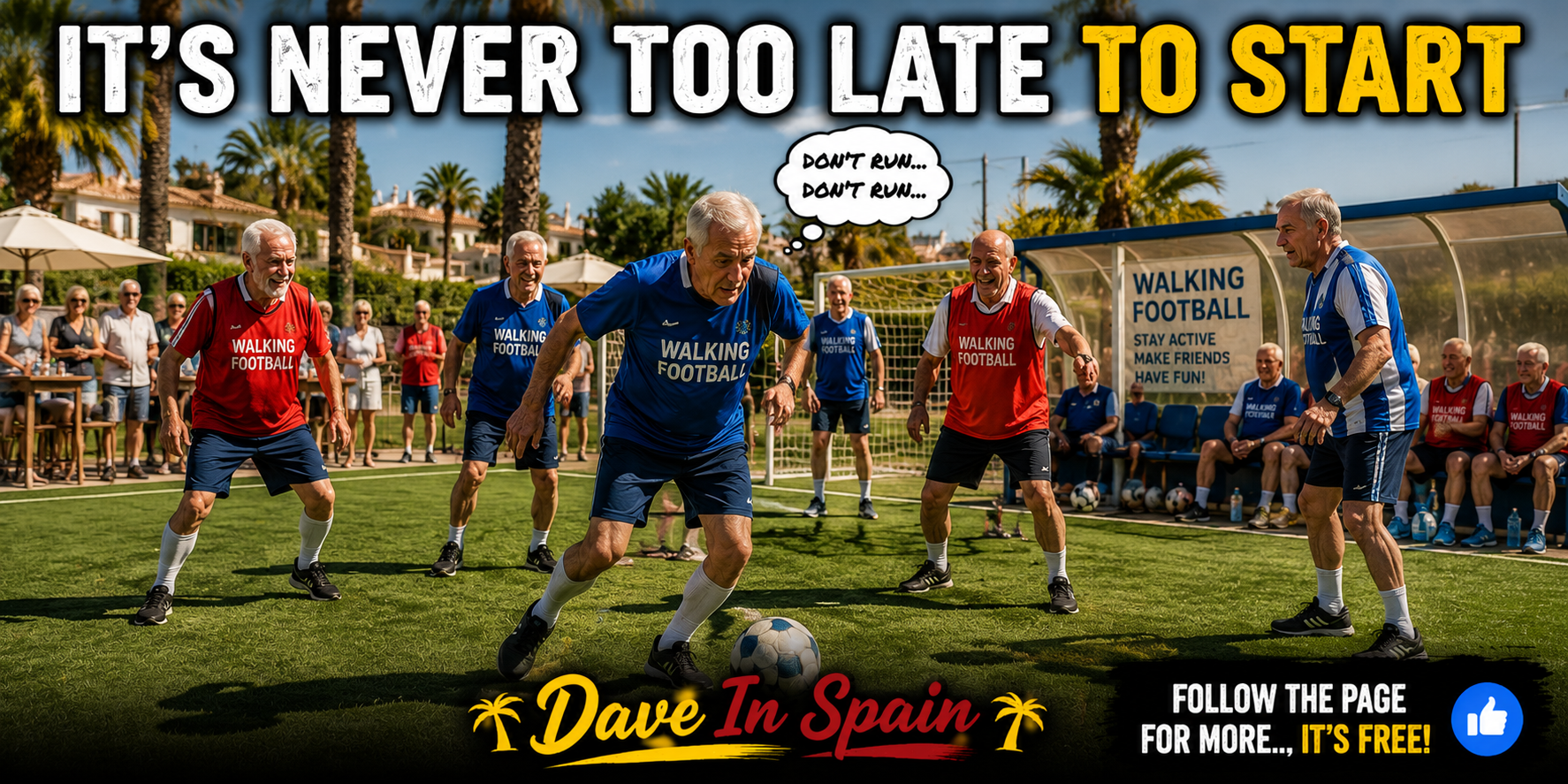
Walking football in Spain is becoming more and more popular, for those living out here. This is one of those things that sounds niche until you see it in Spain and realise it fits the place rather well. The game is slower, the pace is friendlier on ageing knees, and the social side can be just as important as the football itself. In the Costa Blanca South area especially, where a large number of British and other expat residents are looking for active but manageable ways to stay involved, it has the makings of a proper community sport.
Why it works so well in Spain
Spain has a habit of turning ordinary hobbies into a lifestyle. Walking football is no exception. It gives people over 50 — and often well beyond that — a way to keep playing without the sprinting, crunching tackles, or near-fatal enthusiasm that used to leave everyone limping by Tuesday. That matters in a country where many retirees and semi-retirees want to stay fit but also want to avoid the kind of injuries that can put you out for weeks.
The other obvious reason is the weather. In places like the Costa Blanca South, much of the year is made for outdoor activity, though not always at midday in August, when even a short walk can feel like a poor decision. Morning or early evening sessions make far more sense, and that fits the rhythm of life here rather nicely. It also helps that Spain already has a strong football culture, so the sport does not feel imported in a clumsy way; it just slips into local life and starts making friends.
Costa Blanca South and the expat pull
For British residents in the Costa Blanca South — think Torrevieja, Orihuela Costa, Guardamar, San Fulgencio and the wider southern Alicante strip — walking football makes a lot of sense. These are places with sizeable expat communities, decent transport links, plenty of sports facilities, and enough year-round residents to keep regular sessions going. It is the sort of activity where one person comes along for the football and three others come along for the coffee afterwards, then everybody stays because the atmosphere is better than they expected.
That social element is part of the appeal. A lot of people who move to this part of Spain do not just want sunshine; they want structure. A weekly football session gives rhythm to the week, and for people who have played all their lives, or only wish they had, it can be a surprisingly good anchor. The fact that the sport is open to different ages and abilities also means it tends to mix people who would otherwise never cross paths.
How the game actually works
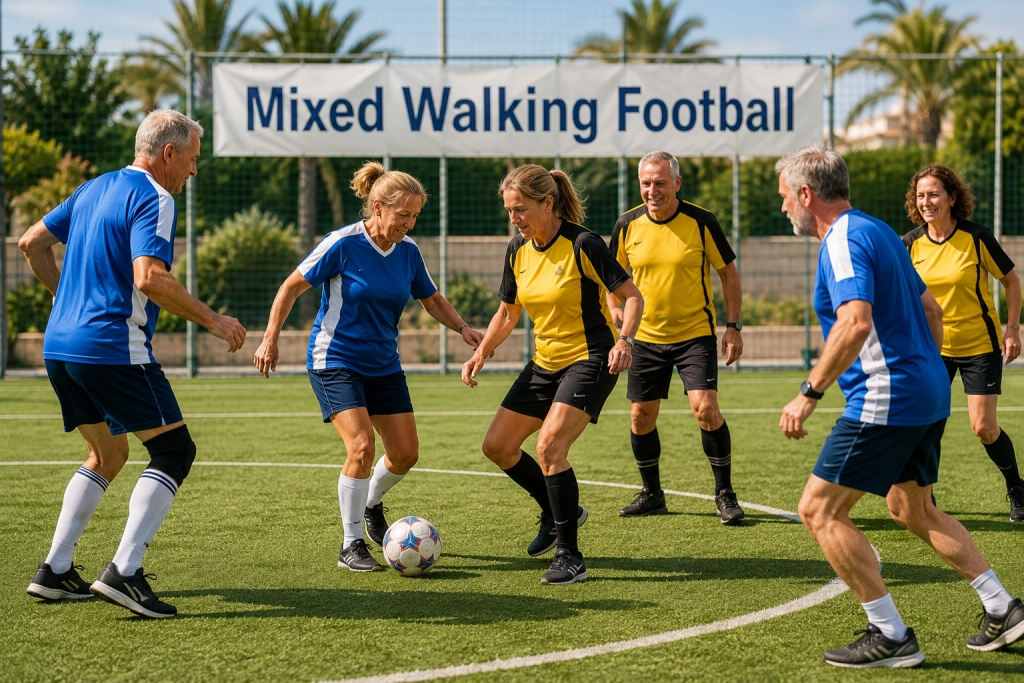
Walking football is not simply “football, but slowly”. It has its own rules, and they matter. Players cannot run, contact is limited, the ball is generally kept below shoulder height, and heading is not allowed in the versions described by Spanish coverage this year. Matches are usually played on smaller-sided pitches, with short halves and an emphasis on passing, control and positioning rather than athleticism for its own sake.
That changes the feel of the game completely. You do not need to be the quickest person on the pitch, and that is rather the point. Good judgement, awareness, and a bit of patience suddenly matter more than raw pace. It also makes the game more inclusive for people recovering from injury, living with mobility limitations, or simply not wanting to spend their Saturday afternoon arguing with their hamstrings.
Typical features
- No running.
- Limited contact.
- No heading.
- Smaller pitches and shorter games.
- Usually mixed or open to different age groups, depending on the club and competition.
- Cheaper than a gym membership!
What it looks like on the ground
Walking football in Spain is no longer just a curiosity. EFE reported in February 2026 that the sport is growing quickly, with dozens of federated teams already and clubs linked to well-known sides such as Athletic Bilbao, Betis and Getafe. In the south, the activity has been visible for years, with one of the better-known examples being Walking Football Spain in Benalmádena, which has built a large community and runs regular sessions.
That matters for Costa Blanca South because it shows the sport is not confined to one region. Spain Walking Football has also developed a broader network and competition structure, including international and regional tournament activity. In other words, if you move here and join a local group, you are not necessarily joining a dead-end kickabout. There is a wider scene around it.
Social life, not just sport
It is easy to underestimate how much people want this sort of thing once they have retired or semi-retired to Spain. Many expats are not chasing elite fitness. They are looking for belonging. Walking football provides a reason to leave the house, a familiar language if you love football, and a built-in way to make friends without the pressure of formal clubs or endless small talk about golf memberships.
That is why it tends to work so well in communities like Costa Blanca South. The football is the hook, but the real value is often what happens afterwards: coffee, breakfast, a drink, a chat, a bit of planning for next week’s game. You can almost feel the social network building itself one session at a time. And in fairness, that can be a huge benefit for people who have moved abroad and still want a sense of routine and camaraderie.
Health benefits without the drama
The obvious appeal is that it is gentler on the body. That does not make it soft or dull; it just makes it sustainable. People who might not risk a full-speed game can still enjoy football, keep moving, and get some decent exercise without being flattened by it. The sport has also been framed in Spanish media as inclusive and suitable for older players, with the emphasis on participation rather than performance.
There is also a psychological side to it that gets overlooked. A lot of people feel better when they have a commitment in the diary. They move more, socialise more, and stop spending quite so much time negotiating with the sofa. For expats in particular, that regularity can be underrated. Spain can be wonderfully relaxed, but too much relaxation and you end up doing very little. Walking football is a decent antidote to that.
Finding a club in Costa Blanca South
If you are living in the Costa Blanca South area, the easiest way in is usually through local expat networks, Facebook groups, WhatsApp communities, or clubs connected to the broader Spain Walking Football scene. The sport often spreads through word of mouth, which is very Spanish in one way and very expat in another. You ask one person at the bar, and by the next week you are on a pitch wondering why you did not start sooner.
Look for sessions in Torrevieja, Orihuela Costa, nearby Alicante province towns, and clubs linked to the larger coastal expat population. The most useful thing is to find a group that suits your ability and your expectations. Some are more social, some more competitive, and some sit neatly in the middle. A quick message before turning up is always wise.
A good fit for Spain
Walking football suits Spain because Spain suits community sport. The weather, the pace of life, the existing football obsession, and the number of older residents make it a natural fit rather than a novelty. In Costa Blanca South, where many residents want to stay active without turning every hobby into a medical event, it feels particularly well matched.
| Team | Area | Contact / Facebook |
|---|---|---|
| Benijófar Community Walking Football Club | Benijófar | Email: benijofarcwfc@gmail.com, Tel: +34 686 54 05 26, website listing shows Campo municipal de Benijofar. Facebook launch post also appears in the club group facebook. |
| Catral Walking Football | Catral | Facebook page: Catral Walking Football facebook. |
| Esquina Park Rangers | Ciudad Quesada / Rojales | Website: esquinawfc.com, Facebook page: Esquina Park Rangers FC esquinawfc+1. |
| Walking Football Spain – Benalmádena | Benalmádena | Facebook page: Walking Football Spain – Benalmadena facebook. |
| Spain Walking Football | Spain-wide / tournament network | Website: spainwalkingfootball.com, Facebook page: Spain Walking Football spainwalkingfootball+1. |
| Walking Football Spain | Costa del Sol / Spain-wide club | Website: walkingfootballspain.com walkingfootballspain. |
| WABOL – Fútbol Caminando | Barcelona | Facebook page: WABOL-futbol caminando, website: wabol.es facebook+1. |
| Íberas Sevilla Walking Football | Sevilla | Mentioned in Spanish TV coverage as a women’s walking football club in Sevilla youtube. |
| Team Spain – Ladies / Men’s squads | Spain-wide | Team page: Team Spain spainwalkingfootball. |
| Walking football in Sevilla / Betis-linked teams | Sevilla | Spanish coverage says clubs linked to Betis are part of the growing federated scene efe+1. |
It is one of those small but telling signs of how life here really works. People come for the sun, the cost of living, or the property market, but they stay because they find routines that feel human. Walking football is one of them. It is exercise, yes, but it is also friendship, habit, and a bit of healthy competition — which, frankly, is often what expat life needs most.


