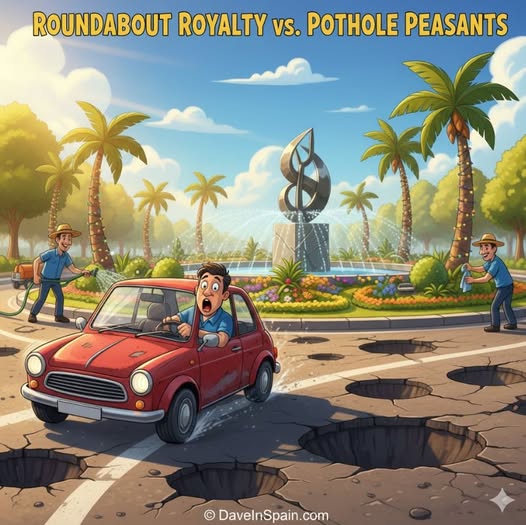
Spanish councils pour love, money, irrigation systems, mood lighting, and a small rainforest into every roundabout… meanwhile the potholes are so deep you could lose a small dog in them. Every drive becomes a slalom course worthy of the Winter Olympics, but by god — that roundabout looks fabulous.
Spain is a country of contrasts — sunshine and storms, siestas and fiestas, and, most notably, roundabouts so beautiful they should have their own TripAdvisor listing… surrounded by roads so battered they resemble the surface of the moon.
You set off on what should be a simple, peaceful drive.
Five minutes. Ten max.
But immediately you find yourself dodging potholes the size of toddler paddling pools. You weave left, then right, then back again, clutching the steering wheel like you’re skiing the black slopes in the Pyrenees.
Your car suspension makes sounds no machine should make.
But then…
You approach the roundabout.
A glorious, towering display of civic pride:
– mood-lit palm trees,
– freshly irrigated flowers bursting with life,
– a dramatic 3-metre sculpture no one understands but everyone pretends to,
– possibly even a fountain shooting water 20ft into the air like it’s auditioning for Las Vegas.
It’s magnificent.
It’s glowing.
It’s immaculate.
You can almost hear trumpets playing as you enter it.
Meanwhile, 20 metres after exiting this horticultural masterpiece, you immediately plunge into a pothole so deep it could qualify as a UNESCO site.
Your British brain struggles to compute:
“How can they maintain a roundabout with the care of a royal garden, yet the road looks like it’s been shelled?”
But that’s Spain.
The roundabout must be fabulous — even if the road leading to it is fighting for its life.
You continue your journey, bouncing along like a budget theme park ride, muttering to yourself:
“At least the roundabout was nice.”
And somehow, that makes it all ok.