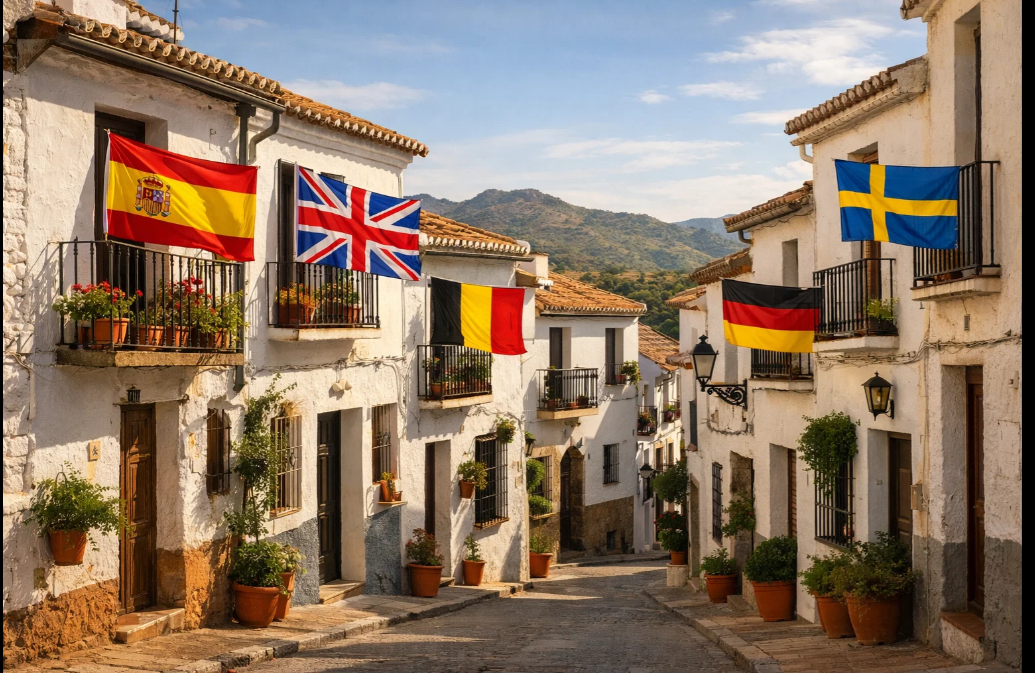
Who’s Really Buying Property in Spain – And Why Prices Keep Going Up.
Spain’s Prime Minister Pedro Sánchez recently criticized the housing market, specifically condemning seasonal lets as “speculation and greed“.
Every time Spanish house prices come up, the same argument explodes online.
“It’s the Airbnb landlords.”
“It’s the banks.”
“It’s the government.”
“It’s the Brits.”
And while all of those play a role, they’re also a convenient distraction from a much bigger, less comfortable truth:
Spain has become one of the most desirable places on Earth to live — and the people buying property here increasingly have far more money than the locals they’re competing with.
For years, British buyers were the easy target. Flip open any newspaper and you’d think half of southern Spain was owned by retirees from Surrey. But the reality in 2025 and heading into 2026 is very different.
The market has changed. Dramatically. just look at how many Belgian & Dutch plated cars are on the roads, and also German number plates too
The Germans Are Now Number One
If there’s one group quietly reshaping the Spanish property market, it’s German buyers.
They’re now the largest group of foreign purchasers in Spain, and they’re not looking for bargain bolt-holes or doer-uppers. Germans typically arrive with strong purchasing power, long-term plans, and very specific expectations.
They favour established, high-quality areas:
Mallorca, the Canaries, the Costa Blanca, Málaga province.
And they care about things many Spanish sellers historically didn’t prioritise:
Energy efficiency, insulation, renovation quality, sustainability.
The result?
Renovated homes with good energy ratings are snapped up quickly — and at prices that locals simply can’t match.
The British Never Really Left
Despite Brexit, paperwork headaches, and endless headlines about 90-day limits, British buyers are back in force.
Why? Because Spain still ticks the same boxes it always did: climate, lifestyle, healthcare, and a massive existing expat infrastructure. Entire towns already operate in English, whether anyone likes it or not.
What’s changed is this: British buyers today are often wealthier than before. Rising UK house prices mean many arrive with substantial equity, able to outbid locals without blinking.
Brexit didn’t kill British demand.
It filtered it — leaving behind those with money and flexibility.
France, the Netherlands, and the Quiet Northern Takeover
French and Dutch buyers rarely make headlines, but they’re consistently among the top purchasers.
The French naturally dominate border regions like Catalonia and the Basque Country, but they’re increasingly visible along the Mediterranean too. Dutch buyers, meanwhile, have been quietly buying in Alicante, Málaga, and inland Andalusia for decades.
Together with Belgians and Scandinavians, they form a steady northern European bloc that sees Spanish prices as reasonable — even cheap — compared to back home.
That perception alone pushes prices up.
The Americans: The Fastest-Growing Shock to the System
If there’s one group causing genuine shockwaves, it’s Americans.
They’re still smaller in absolute numbers, but growth has been explosive. A strong dollar, remote work, and a growing sense that Europe offers a better quality of life have made Spain suddenly fashionable in US circles.
Americans are buying in Madrid, Barcelona, Marbella, Ibiza, and even northern Spain. And they’re used to paying prices that would cause outrage locally.
When an American buyer shrugs at €900,000 because it would be double that in California, the market adjusts accordingly.
Upwards.
Not All Foreign Buyers Are “Holiday Home” Buyers
One inconvenient truth rarely discussed is that many foreign buyers are not tourists or investors.
Moroccan buyers, for example, represent a large share of foreign purchases, particularly in Andalusia and southern regions — often for permanent residence.
Eastern Europeans, Italians, Irish, Swiss — many are working remotely, starting businesses, or relocating entirely.
Spain isn’t just selling sun anymore.
It’s selling life.
Why This Pushes Prices Up — Relentlessly
Put simply:
Spain’s housing supply has not kept up with demand.
Construction collapsed after 2008 and never truly recovered. Planning rules are slow, local opposition is fierce, and political paralysis means supply remains tight.
Now add:
• Wealthy northern Europeans
• Americans with dollar power
• Remote workers earning foreign salaries
• Investors seeking stability
• Retirees with paid-off homes abroad
And you get exactly what we’re seeing: prices rising faster than local wages, especially in desirable areas.
This isn’t speculation.
It’s structural.
The Uncomfortable Reality
Blaming one group — Airbnb owners, Brits, foreigners in general — might feel satisfying, but it misses the point.
Spain is popular because it’s successful at what it offers.
And until housing supply increases, or wages rise meaningfully, property will continue drifting out of reach for many locals — not because of one villain, but because Spain has become a global destination in a globalised housing market.
That’s the reality.
And it’s not going away any time soon.
Key Trends Influencing 2025/2026:
- Northern European Dominance: The core demand remains from Northern Europeans seeking sun and a better quality of life, with Germany leading the pack.
- The “Remote Work” Effect: This continues to benefit Spain, attracting younger professionals and non-traditional buyers (e.g., from the USA, Italy) who are not just looking for retirement homes.
- Shift from Pure “Sun & Beach”: While coastal areas remain king, there is growing interest in inland cities (Madrid, Valencia, Sevilla) and rural depopulated areas (“Empty Spain”) for authenticity and value.
- Sustainability & Energy Efficiency: A major growing concern, especially for German and Nordic buyers, who increasingly prioritize properties with good energy ratings and sustainable features.
Summary for 2025/2026:
The #1 spot is held by Germans, with the British, French, and Dutch completing the top tier. The most dynamic growth is coming from American buyers, while the Nordic and Benelux markets remain steadfastly strong.
Source Note: This projection is based on the latest full-year data from Spain’s Colegio de Registradores (Registrars’ Association) and reports from major property portals like Idealista, factoring in the clear trends observed from 2022 through 2024.


